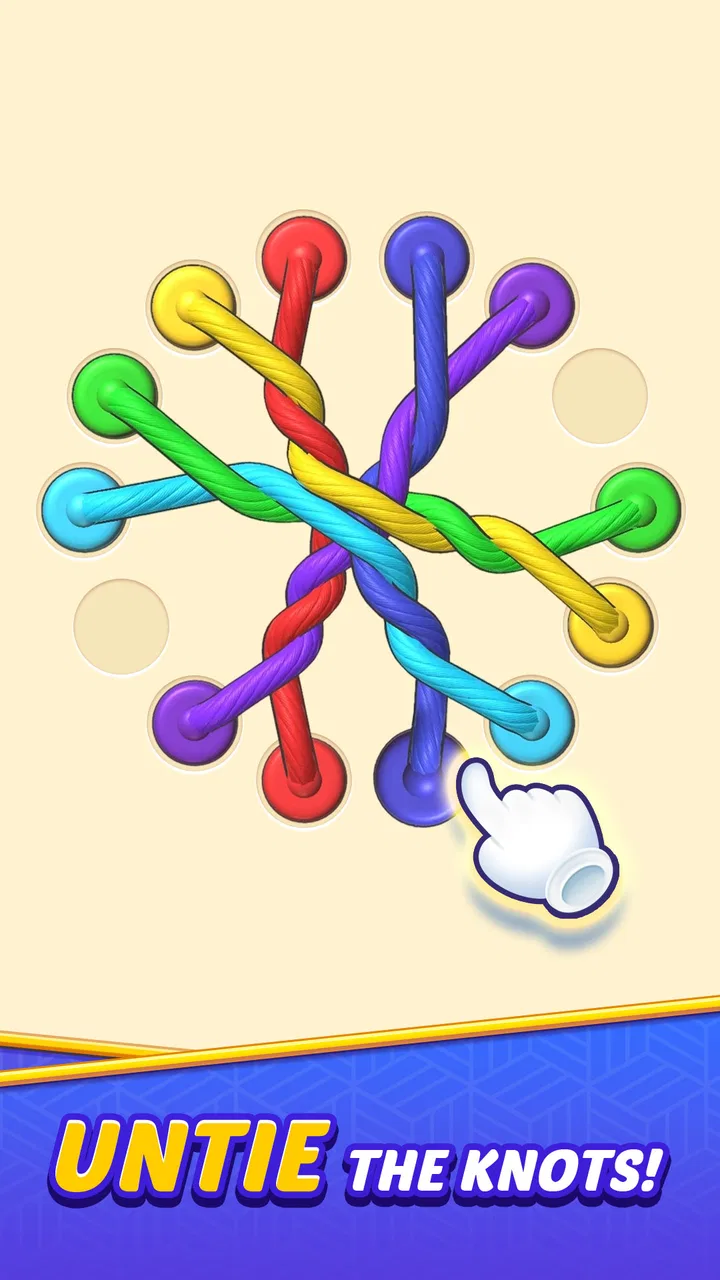
Tangled Rope: Twisted Puzzle
- 4.3
- Rating
- 1.00M
- Installs
- Free
- Price

 Analysis by App-foxy
I usually know within the first few minutes whether a puzzle game is going to earn a place on my phone. With Tangled Rope: Twisted Puzzle, the answer depends less on flashy presentation and more on whether you enjoy carefully planning a sequence of moves. This is a free puzzle game from NORDKAPP GAMES LIMITED built around untangling ropes, and its appeal comes from turning a simple visual problem into a surprisingly deliberate one.
That basic idea is easy to understand: ropes are tangled, and I need to work out how to separate them. The challenge is not learning complicated controls. It is seeing the board clearly, predicting what will happen when I move one rope, and avoiding a choice that makes the remaining arrangement harder. That makes it a good fit for short sessions, quiet concentration, and anyone who prefers spatial reasoning over fast reactions.
I would not recommend it automatically to every puzzle fan, though. Players looking for a story, a large variety of puzzle rules, or a more relaxed matching game may find the central mechanic too narrow. My experience is that the game works best when I treat it as a focused brain teaser rather than an all-purpose mobile game.
You May Also Like

 Blood Strike: 2.5 Anniversary
Blood Strike’s Loadouts Turn Every Drop Into a Tactical Gamble
A close look at Blood Strike’s custom loadouts: how fast access to signature weapons reshapes its battle royale rhythm, rewards preparation, and narrows the gap between fights.

 Pandora - Music & Podcasts
Pandora’s Music Is Easy to Start, but Harder to Recover
Pandora’s strength is its low-effort path from a seed to a station. Its weak spot is how much confidence it asks you to place in connection, setup, and quiet recovery.

 8 Ball Pool
 Is Built on Rivalries, Rematches, and Routine
A close look at the rivalries, rematches, shared routines, and unanswered safety questions that turn a quick pool match into a persistent mobile community.

 Samsung Music
’s Quiet Strength Is Playing What You Already Own
Its reach comes less from spectacle than from dependable access to a personal library. That simplicity is both the app’s strongest retention engine and its ceiling.

 AccuWeather: Weather Radar
AccuWeather Review: A Quick, Clear Forecast for Everyday Decisions
For everyday plans, the best forecast is the one you can understand quickly. AccuWeather makes rain timing, radar, and local conditions easy to act on, with a few trade-offs.

 Hill Climb Racing
Why Hill Climb Racing Still Turns Crashes Into One More Run
A tiny car, a bumpy hill and one more upgrade: Hill Climb Racing keeps resurfacing because its simple chaos makes every near-miss feel personal.
More From Our News Desk
View All News


What to consider before choosing Tangled Rope
I’d judge this game by whether its rope puzzles still feel satisfying once the first novelty wears off, not just by how quickly the idea makes sense. Before installing, I’d consider how much patience I want to give a single visual challenge and whether that kind of attention fits my routine; the next section looks at what it offers alongside familiar puzzle choices.
The central question is whether you enjoy planning before acting
The most important decision criterion is your relationship with mistakes. Rope puzzles often punish the first move that looks convenient, because moving one piece can block access to another or create a less manageable crossing. I found myself slowing down naturally, tracing the visible paths and asking which rope seemed to be on top before touching anything.
That makes the game more thoughtful than its short description suggests. It is not simply a matter of dragging objects until the screen looks tidy. The satisfying moments come from recognizing an order of operations: free one section, preserve room for the next, and only then deal with the knot that initially attracted attention.
If you enjoy sorting games, line puzzles, or compact spatial challenges, this structure should feel familiar without being identical to them. If your favorite mobile puzzles are based on quick matching, word clues, or immediate rewards, the slower pace may feel like work rather than entertainment.
Touch control matters more than visual complexity
Because the game revolves around selecting and moving ropes, the quality of a session depends on how confidently I can identify the intended object. On a small phone screen, overlapping colors and crossings can demand extra attention. I recommend playing with the screen clean and using a comfortable grip, especially when a puzzle contains several nearby rope sections.
A useful habit is to avoid tapping repeatedly when a move does not behave as expected. I get better results by pausing, checking which rope is actually accessible, and then making one deliberate gesture. That approach reduces accidental moves and turns the game into a visual exercise instead of a test of frantic finger speed.
The game is rated for Everyone and supports devices running Android 7.0 or later. That gives it a broad practical audience, including people using older compatible phones. I still prefer a larger display when I want to study a complicated arrangement, while a phone is perfectly convenient for a quick puzzle during a break.
Short sessions are a natural use case
I can imagine opening this game while waiting for an appointment, commuting when seated, or taking a short break between tasks. A typical session does not require the kind of uninterrupted commitment associated with a long adventure game. I can inspect a puzzle, make progress, stop, and return later without needing to remember a complicated plot or control system.
That simplicity is one of its strongest practical qualities. For example, if I have ten quiet minutes before leaving home, I can use the game as a focused reset instead of scrolling through several unrelated apps. The visual problem gives my attention one clear target, and the act of untangling feels more purposeful than passive browsing.
There is also a useful difference between playing for relaxation and playing for stimulation. The game can be calming when I accept its pace, but it can become frustrating if I keep forcing a solution after overlooking the rope order. When I reach that point, closing it for a few minutes is usually better than repeating the same unproductive attempt.
What the public response suggests
The game has an average rating of 4.3 from around 52 thousand ratings, with over 800 written reviews and more than a million installs. Those figures indicate that the premise has reached a substantial audience and that many players find the format approachable. They do not guarantee that every puzzle style preference will match mine, but they make the game a reasonable candidate for anyone curious about rope-based logic puzzles.
Its current version is 0.68.0, so I would keep the app updated rather than judging it only by an older session. Updates can matter in a puzzle game because small adjustments to presentation, level flow, or interaction can change how comfortable the experience feels, even when the basic idea remains the same.
Where the game wins against familiar puzzle alternatives
What stands out to me is the way rope untangling asks me to preserve options and reason about order, rather than chase a quick match or rely on a surprising physical reaction. That distinction can make it a welcome change when I want a self-contained planning task, though it also points to the kinds of puzzle games that may suit different moods better.
It turns a simple rule into a visual planning exercise
The strongest part of Tangled Rope is its focused identity. Many mobile puzzle games combine several systems: coins, timers, power-ups, characters, daily tasks, and progression screens. Here, the rope arrangement remains the reason I am playing. That focus makes each successful solution feel connected to my own observation rather than to a boost or a lucky combination.
Compared with match-three games, it asks for fewer reflexes and more patience. Compared with word puzzles, it replaces vocabulary with visual interpretation. Compared with physics puzzles, it offers a more orderly type of problem: I am not mainly experimenting with unpredictable motion, but trying to understand which move should come next.
That distinction makes it particularly suitable for players who like to solve mentally before interacting. I often get the most satisfaction when I can see a complete route in my head and then execute it cleanly. The game rewards that kind of restraint more than rapid tapping.
The best strategy is to preserve options
One non-obvious lesson I took from playing is that the apparently easiest rope is not always the best first target. I now look for moves that open space or expose another rope while keeping several future choices available. This is a more reliable approach than simply removing whatever crossing looks most tangled.
When a board feels crowded, I mentally divide it into small zones. I identify which rope appears to run across the largest number of others, then check whether moving it would genuinely help or merely shift the obstruction. I also try to avoid committing to a corner or edge too early if that move could leave the center inaccessible.
These habits are useful because they turn the game from trial and error into a repeatable workflow:
Scan the entire arrangement before touching a rope.
Find the moves that create space rather than only changing position.
Make one move, then reassess the new crossings.
When stuck, undo the assumption behind the last move instead of tapping randomly.
The final step is especially important. A failed attempt often does not mean the whole puzzle is beyond me; it may mean I chose the wrong starting point. Reconsidering the first decision is more productive than blaming the later moves.
It is accessible without being completely mindless
The rope concept is immediately readable, which helps new players begin without a long tutorial. At the same time, the visual simplicity leaves room for genuine difficulty. I do not need to memorize rules, but I do need to notice relationships between objects and think several actions ahead.
That balance is where the game wins over very casual alternatives. A simple coloring or matching game may be easier to start, but it can become background entertainment. Tangled Rope gives me a reason to stay mentally present. The trade-off is that it is less suitable when I want to play with one hand while concentrating on something else.
Free access lowers the barrier to trying it
The game is free to download, which makes testing the core idea straightforward. It also includes in-app purchases ranging from $0.99 to $99.99 per item. I would treat that range as a reason to check purchase prompts carefully, particularly if a child is using the device or if I am trying to keep a game completely cost-free.
The free entry is valuable because this is a preference-driven genre. No description can tell me whether untangling ropes will feel satisfying or repetitive after several sessions. Being able to try it before committing money is more useful here than it would be in a game whose appeal depends on a large narrative or a famous franchise.
Where the focused design can become a weakness
The same narrow focus that makes the game recognizable may eventually limit its variety for some players. If I want changing puzzle types, character development, or a story that gives every session a larger purpose, this is not the strongest choice. Its pleasure comes from refining my approach to one central problem, not from constantly learning new systems.
I also would not choose it as my first option for social play. The experience is naturally individual: I am studying a board and making decisions at my own pace. Someone seeking competitive matches, cooperative solving, or a shared party activity should look toward another puzzle category instead.
When a different puzzle category fits better
A focused mechanic is a strength when I want to practice one kind of spatial thinking, but it can feel limiting if I’m craving fresh rules or a faster rhythm. I’d choose another category when its style better matches my available attention, and the following comparison helps clarify when that switch is likely to be worthwhile.
Choose matching games for speed and low commitment
If I want something I can play almost automatically for a few minutes, a traditional matching game may serve me better. Those games usually communicate the next action instantly and provide a faster rhythm. Tangled Rope asks me to stop and inspect the arrangement, so it is a poor substitute when my attention is divided.
The choice comes down to the kind of mental effort I want. Matching is better for quick stimulation and familiar repetition. Rope untangling is better when I want a contained problem that rewards visual planning. Neither approach is universally superior; they simply occupy different moods.
Choose word puzzles when language is your strength
Word games are a better alternative for players who enjoy clues, spelling, vocabulary, or general knowledge. They can also be more portable mentally because the challenge may continue away from the screen. Tangled Rope offers no equivalent language layer; its challenge is entirely visual and spatial.
I would especially steer a word-game fan elsewhere if the idea of tracking overlapping paths sounds tiring. On the other hand, people who struggle with vocabulary puzzles but enjoy arranging objects may find this game more welcoming. It tests a different kind of attention and does not require a large word bank.
Choose physics or sorting puzzles for more experimentation
Physics-based puzzles are a stronger fit when I want to experiment and observe unexpected results. Sorting games are preferable when I enjoy organizing colors, shapes, or categories according to clear rules. Tangled Rope sits between those experiences: it has a visual arrangement to manipulate, but its appeal is mainly in selecting the correct order rather than discovering a surprising simulation.
This comparison also explains who should skip it. I would not make it my main recommendation for someone who needs constant novelty from one level to the next, or for a player who becomes irritated by examining a board before every action. The game is at its best for people who enjoy narrowing possibilities.
Think about attention, not just free storage
Before switching from another puzzle game, I would ask what currently causes me to stop playing. If the problem is excessive complexity, Tangled Rope may feel refreshingly direct. If the problem is repetition, moving to another single-mechanic puzzle may not solve anything. In that case, a game with several puzzle modes would be a better change.
The cost of switching is low in terms of learning: the rope concept is easy to understand. The bigger adjustment is behavioral. I need to accept slower progress, deliberate observation, and the possibility that the correct move is not the visually most obvious one. Players who enjoy that adjustment will probably settle in quickly; players who want instant feedback may abandon it just as quickly.
My recommendation after weighing the trade-offs
My recommendation comes down to whether deliberate visual problem-solving feels like a satisfying habit or an obligation. I’d give this game room in my rotation if I enjoy returning to its central challenge, but I wouldn’t keep it installed out of loyalty if I find myself wanting more variety; the closing section weighs that trade-off for different players.
Who should install it
I recommend Tangled Rope to anyone who likes compact spatial puzzles and wants a free game that can fill short, focused sessions. It is especially appealing if you enjoy planning sequences, spotting hidden relationships between objects, and solving a problem without relying on fast reflexes. The Everyone rating also makes it approachable for a broad audience, although younger players may still benefit from supervision around optional purchases.
I think it is a good companion app for a quiet commute, a waiting room, or a short evening break. I would also suggest it to players who have grown tired of puzzle games built around constant rewards and want the board itself to provide the motivation.
Who should look elsewhere
I would skip it if I need a story, multiplayer interaction, dramatic progression, or a wide collection of unrelated challenges. I would also choose a faster matching game when I only have enough attention for quick taps. The rope mechanic requires me to look closely, and that requirement is central rather than something I can turn off.
Players who dislike restarting a plan after a poor opening move may find the experience frustrating. My advice is to treat mistakes as information and to pause before the next attempt. If that kind of reflective play feels more like a chore than a reward, another puzzle category will probably suit you better.
How I would approach the first session
I would begin without trying to solve every board as quickly as possible. Instead, I would spend the first few puzzles learning how the ropes overlap and which visual cues make a move safe. I would keep my gestures slow, look for space-opening actions, and avoid assuming that the most tangled-looking area deserves immediate attention.
I would also decide in advance whether I am comfortable with optional spending. Since the game is free but offers individual purchases from $0.99 up to $99.99, setting device purchase controls before handing over the phone is sensible. That small preparation prevents the cost question from interrupting an otherwise simple puzzle session.
The bottom line
Tangled Rope: Twisted Puzzle earns my recommendation as a focused, accessible puzzle game rather than as a universal replacement for every mobile brain teaser. NORDKAPP GAMES LIMITED has chosen a clear premise, and the game’s strongest quality is that it asks me to think about order, space, and consequences without surrounding that idea with unnecessary complexity.
Its rating of 4.3 and audience of over a million installs show that the concept has broad appeal, while the real test is personal: do you enjoy untangling a visual problem one careful move at a time? If yes, the free download is an easy experiment and may become a dependable short-session game. If you need variety, story, social play, or constant speed, I would choose a different puzzle style instead.
For me, the deciding factor is the feeling after a difficult solution. I am not merely clearing a board; I am confirming that I understood the structure correctly. That makes this a worthwhile pick for patient puzzle fans, with the honest warning that its focused design is also its main limitation.
FAQs for Tangled Rope: Twisted Puzzle
01What is Tangled Rope: Twisted Puzzle?
Tangled Rope: Twisted Puzzle is a casual puzzle game centered on untangling colorful ropes. Each level presents ropes that overlap, cross, or connect around obstacles, and your goal is to move them in the correct order until the board is clear. The game is easy to understand, but later stages require careful planning, patience, and attention to the movement of every rope.
02How do you play Tangled Rope: Twisted Puzzle?
To play, select and move the available rope ends or pins according to the controls shown on screen. The objective is to separate the tangled ropes without creating new intersections or blocking another piece. Early levels work as a gentle tutorial, while more advanced puzzles demand that you think several moves ahead. Taking your time is usually more effective than making quick taps.
03Is Tangled Rope: Twisted Puzzle suitable for children and beginners?
Yes, the game is generally suitable for beginners because its basic mechanics are simple and the early puzzles introduce the rules gradually. It does not require fast reflexes, complex controls, or previous puzzle experience. However, some later levels may be challenging for younger players, especially when several ropes and obstacles appear at once. Adult supervision is still recommended for children using mobile devices.
04Does Tangled Rope: Twisted Puzzle work offline, and does it contain ads?
The game is designed as a casual mobile experience, so many puzzle sessions can usually be played without a constant internet connection. Nevertheless, certain features, advertisements, updates, or optional rewards may require connectivity depending on the version installed and the device platform. Players should also expect advertising in the free version, particularly between levels or when requesting extra hints.
05Are there hints, purchases, or any important limitations to know before downloading?
Tangled Rope: Twisted Puzzle may provide assistance through hints, level solutions, or optional rewards when a puzzle becomes difficult. These features can be useful, but they may be limited or connected to advertisements or in-app purchases, depending on the current release. Before downloading, check the store listing for the latest information about permissions, pricing, ads, supported devices, and available content.
Pros
- Simple controls make the game easy to pick up immediately.
- Short levels suit quick play sessions during commutes or breaks.
- Colorful visuals make the tangled ropes easy to distinguish.
- Gradual difficulty provides a comfortable learning curve.
- Offline play is useful when you have no internet connection.
Cons
- Later puzzles can feel repetitive once the core mechanic is familiar.
- Some levels may require trial and error rather than pure planning.
- Ads can interrupt the flow between completed puzzles.
- The game offers limited variety beyond untangling rope layouts.
- Players seeking deep strategy may find the mechanics too simple.

Tangled Rope: Twisted Puzzle
Gallery